
She'd spent years as a software analyst. Back-end systems, technical constraints, how information moved through a product — she understood all of it. But when she described moving into product design, she talked as if that experience belonged to an old career and she'd have to begin again.
The obvious response is to fill the visible gaps: learn Figma, study interface patterns, build a portfolio, apply for junior roles. Those may be part of the transition. But the more we talked, the less starting over made sense.
Career changers often hide the experience that could make them distinctive, simply because it doesn't look like the job they want next.
If you're moving into product design, don't erase the path that brought you there. Translate it.
A Career Change Is Not a Factory Reset
Product design has a recognizable set of outputs. Portfolios show research, flows, wireframes, prototypes, and polished interfaces. A person entering from another field can look at that list and see only what they have not done.
Hiring processes reinforce the feeling. Job descriptions ask for years in a design role. Portfolio examples follow a familiar case-study structure. Entry-level advice tends to focus on tools because tools are concrete and teachable.
But product teams do not hire designers only to operate design software. They hire people to understand a problem, work through constraints, make decisions visible, and help a team deliver something useful.
Many career changers have already practiced parts of that work under different names.
A software analyst may understand dependencies, edge cases, and what happens when a clean interface meets a complicated system. A customer-support lead may recognize recurring friction long before it appears in a dashboard. Someone from operations may know where handoffs break and which exception quietly consumes hours each week. A teacher may know how to sequence unfamiliar information and notice when understanding falls apart.
None of those backgrounds automatically makes someone a product designer. They do create useful evidence. The work is to connect that evidence to the decisions a product designer needs to make.
Translate the Skill, Not Just the Title
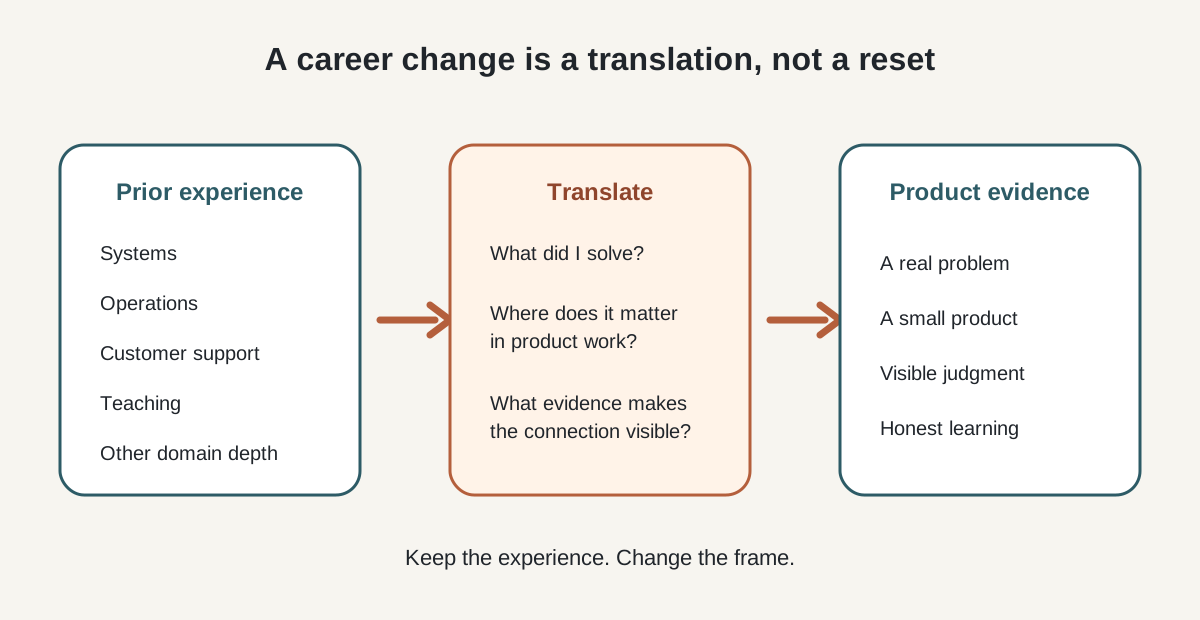
Saying “I used to work in operations” leaves the listener to decide whether the experience matters. Translation makes the connection explicit.
Try moving through three questions:
- What did I repeatedly notice or solve? Look for behaviors, not job descriptions: clarifying unclear requests, mapping systems, finding failure points, balancing competing needs, or helping different groups reach a decision.
- Where does that behavior appear in product work? Connect it to discovery, information architecture, service design, interaction design, facilitation, delivery, or measurement.
- What evidence shows I can apply it here? Use a project, prototype, workflow analysis, or specific story that lets another person inspect your reasoning.
The translation might sound like this:
> My analyst background taught me to trace how a decision moves through a system. In product design, I use that skill to identify hidden states, ask engineers about dependencies early, and keep a simple interface from creating complicated failure modes downstream.
That is stronger than treating technical experience as a side note. It names the capability, shows where it matters, and gives the hiring team something to explore.
It also avoids the opposite mistake: claiming that adjacent experience removes the need to learn design. It does not. Translation should make your starting advantage visible without pretending the gaps are gone.
Build the Bridge With a Small Product
A career-change portfolio can easily become a collection of large fictional redesigns. The screens look finished, but the project reveals little about how the person finds a problem, sets scope, responds to constraints, or learns after the first attempt.
I would rather see a small, working utility built around a real frustration.
It could track recently copied color values, prepare recurring meeting notes, compare two sets of data, or remove a repetitive step from a personal workflow. The idea does not need to become a startup. It needs enough reality to push back.
A useful small product creates questions:
- Who has this problem besides me?
- What context can the system already know?
- What is the smallest useful action?
- Which edge case changes the design?
- What should happen when the data is missing or wrong?
- What did someone do that I did not expect?
This is where AI can help without becoming the point of the project. It can help a career changer generate a prototype, inspect code, organize feedback, or try a direction that would otherwise take too long. But the portfolio still needs to show why the product works the way it does and what changed after contact with reality.
As I wrote in From Figma to Function, designers do not need to become engineers. They should understand implementation well enough to ask better questions and make design intent more durable. Someone arriving with technical depth already has part of that bridge. A small product helps demonstrate how they use it.
Do Not Let the Tool Become Your Identity
When people feel behind, they often lead with the newest evidence they have: a Figma certificate, a bootcamp, an AI tool, or a polished practice project.
Those signals can show effort. They rarely explain why a team should remember you.
The more useful positioning sits at the intersection of old depth and new capability. Not “I am a generalist who can do anything,” and not “I am new, but I learn quickly.” Something more specific:
- a researcher who understands regulated operations;
- a product designer who can reason through complex systems;
- a former support lead who designs for service recovery;
- a visual designer who can carry interaction intent into the front end.
Specificity does not trap you in your old career. It gives people a clear first reason to believe you can help.
This matters in a noisy hiring process. The first person reviewing a resume or portfolio may not have enough time or design expertise to infer the connection. If your useful difference requires five minutes of explanation, it may never become visible.
Your opening statement, first project, and case-study framing should all make the bridge clear. The details can add range later.
Show the New Skill in the Context of the Old One
A strong transition story does not separate the past and future into two unrelated chapters. It shows where they meet.
For each case study, make four things easy to find:
- The product question. What did someone need, and why did it matter?
- The relevant advantage. What did your prior experience help you see earlier or understand more deeply?
- The design judgment. What did you choose, change, or leave out?
- The evidence. What did you build, test, observe, or learn?
This is close to the portfolio principle I described in When AI Makes the First Draft, Your Portfolio Needs to Show Your Judgment. A finished artifact is not enough. The value sits in the reasoning that changed the work.
For a career changer, that reasoning also proves something important: the prior experience is not merely a biography. It affects the product decisions.
Be honest about the boundary. If the project did not ship, say so. If you tested with three people, do not turn that into a broad market claim. If AI generated part of the implementation, explain what you directed, reviewed, and changed. Credibility grows when the evidence stays proportional to the claim.
Keep the Experience. Change the Frame.
Moving into product design takes new practice. You need to learn how to study behavior, structure information, explore interactions, communicate decisions, and work with product and engineering through delivery. There's no useful shortcut around that.
But learning a new discipline doesn't require pretending your previous work had no value.
The strongest career-change story was never about escaping an old identity. It's about carrying forward a capability product teams need, and proving you can apply it in a new context.
Learn the tools. Build the portfolio. Practice the craft. Then make the bridge visible.
You're not starting from zero. You're starting from experience that needs a new frame.