
All the attention goes to the visible work: generating screens, writing copy, producing concepts, turning a prompt into a working prototype. Easy to demo. Concrete to react to. It makes AI feel immediate.
I use some of those tools too. They're useful. But the biggest near-term opportunity is probably the work nobody wants to show in a demo.
The Work Between the Work
Product teams spend a surprising amount of time translating the same idea from one format into another.
A designer explains a flow in Figma. A product manager rewrites it as a ticket. An engineer asks about the states the ticket missed. Someone updates the acceptance criteria. Another person copies the decision into a release note. Later, the team tries to reconstruct why the decision happened.
Each step makes sense on its own. Together, they create a layer of administrative work around the product.
I do not think all of that work is waste. Teams need shared language, clear decisions, and enough documentation to move without guessing. The problem starts when the documentation becomes a substitute for alignment instead of evidence of it.
That is where AI gets interesting to me.
AI as Translation Infrastructure
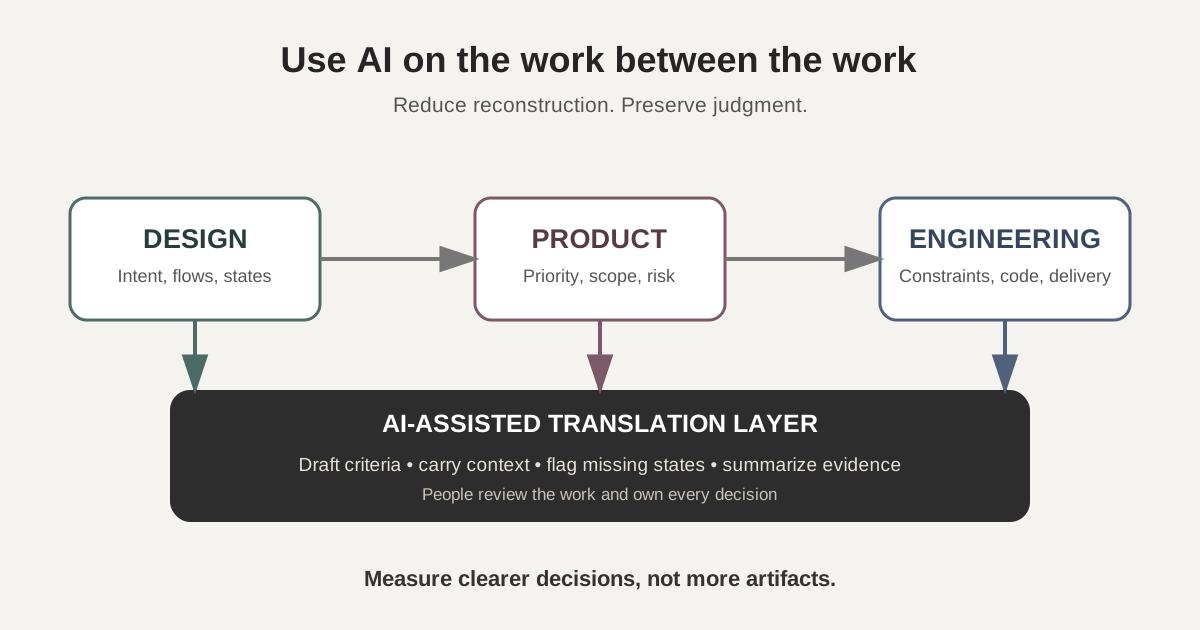
The useful version of AI does not make the product decision. It helps the decision survive the trip from design to product to engineering.
A team could use AI to turn a design walkthrough into draft acceptance criteria, identify missing states, summarize research evidence, compare implementation against design intent, or produce a first pass at release notes.
None of those tasks should run without review. They still require judgment. They also require someone who understands the product well enough to catch what the system missed.
But the first pass matters.
A blank Jira ticket asks someone to reconstruct the whole feature. A draft based on the actual design gives the team something to challenge. A pile of research notes asks someone to find the pattern. A structured summary gives the researcher a place to test whether the pattern holds.
The distinction is important. AI should reduce reconstruction, not remove responsibility.
The Goal Is Better Decisions, Not More Output
This is the part I think product leaders need to watch.
If AI helps a team produce twice as many tickets, screens, and documents, the organization may call that productivity. The team may simply inherit twice as much material to review, reconcile, and maintain.
More output can create more drag.
The useful measure is whether the team makes better decisions with less friction. Did engineering understand the intent earlier? Did design catch an edge case before development? Did product spend less time rewriting information that already existed? Could the team explain a tradeoff without searching through six disconnected tools?
Those outcomes are harder to show in a demo. They are also closer to the work that determines whether a product ships well.
I wrote before about how design leadership in the age of AI still depends on judgment, alignment, and measurable outcomes. The tools have changed quickly. The leadership question has not: where does the team lose time, clarity, or confidence?
Start With the Friction You Already Have
I would not start by asking where a team can add AI.
I would start by looking for repeated translation.
Where does the same information get rewritten? Where do questions arrive late because the handoff hid an assumption? Where does someone spend an hour assembling context that already exists across notes, tickets, and designs? Where does the team maintain documentation that nobody trusts enough to use?
Those moments make better candidates than a general mandate to “use AI.”
They also keep the work grounded. The team can compare the new workflow against a real baseline: time spent, rework created, questions raised, states missed, or decisions delayed.
The first version does not need to automate the whole process. It may only prepare a draft, flag inconsistencies, or gather context before a meeting. That can still matter if it gives people more time for the work that needs them.
Keep People in the Judgment Loop
The unsexy work carries risk precisely because it looks routine.
A summary can flatten disagreement. Acceptance criteria can make an uncertain decision look settled. A generated ticket can repeat the wrong assumption with impressive confidence. A design QA tool can flag visual differences while missing the product reason behind them.
Human review is not a temporary compromise until the technology improves. It is part of the operating model.
Someone needs to own the decision, understand the source material, and know when the generated answer feels too clean. The goal is not to remove people from the process. The goal is to stop spending their attention on reconstruction.
That difference matters for team health too.
When AI absorbs routine translation and administrative setup, people can spend more time discussing tradeoffs, testing assumptions, and improving quality. When AI only increases the expected volume of work, it becomes another source of pressure.
Better tools do not automatically create better work. Teams still have to decide what the reclaimed time is for.
The Part Worth Measuring
I don't have a tidy rule for where AI belongs on every product team. I do have a test: after the workflow changes, do people have more room for judgment?
Designers spending less time rebuilding context and more time protecting the experience — that matters. Product managers spending less time copying information and more time clarifying priorities — that matters. Engineers receiving clearer intent before implementation — that matters.
The most valuable AI work may never produce the most impressive demo. It may look like fewer missing states, cleaner handoffs, shorter meetings, decisions that survive the distance between teams.
Not the flashy version of AI. Possibly the version that actually changes how product teams work.