
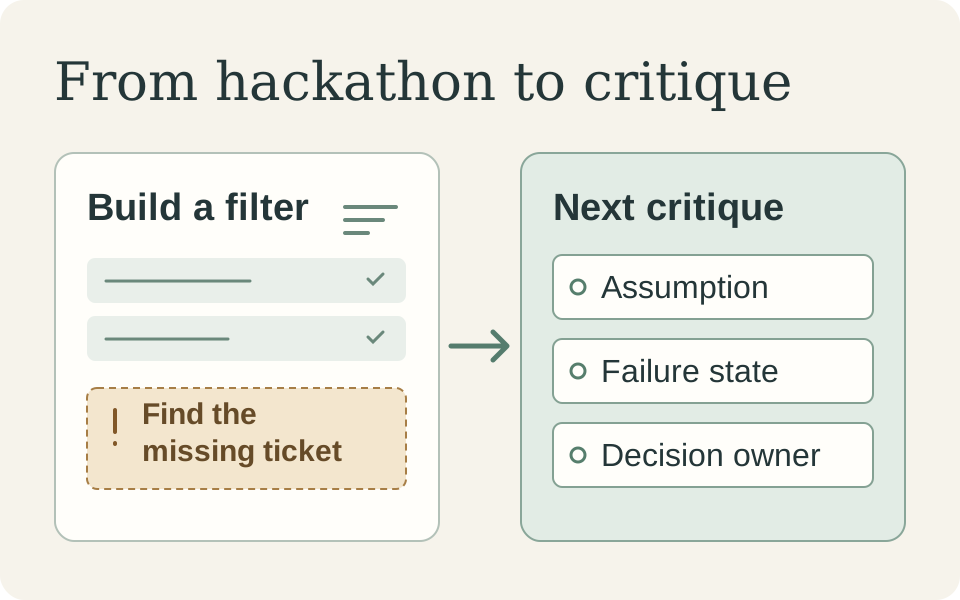
At the end of an AI hackathon, a team can show a working dashboard filter and still have an unanswered question. What happened to records the prototype didn’t recognize? I’d judge the exercise by whether the team can explain that decision and use the same review on its next project.
An AI hackathon for a design team works best when leaders choose one skill before they choose the challenge. Pick something you want to see in regular product work, like reviewing generated behavior against a design-system rule or making a failure state visible before engineering review.
Choose One Skill and One Small Challenge
Suppose the skill is reviewing AI-generated behavior. Give pairs a small support dashboard, an existing filter component, and sample tickets. Ask them to make the status filter work using the component the product already supports. Put one ticket in the exercise with a status that the filter options don’t cover.
Practice goal: Build the filter, then show which rule came from the product, which behavior the AI supplied, and what happens to a ticket with an unfamiliar status.
Provide a starter repository and enough setup time for everyone to run it. Have one person direct the tool while the other checks the component guidance and walks through the result. Swap roles for the unknown-status case so each person gets time to build and review. Use sample data so the exercise can be repeated without depending on customer records.
Review the Decision the Demo Hid
During the review, ask each pair to show the filter with the unfamiliar ticket present. Suppose the generated code drops that ticket from the default view. The dashboard can still look complete while leaving a support agent unaware of an open issue. The team has a product decision to make about where unknown statuses appear and how the agent can tell that they need review.
Ask for three things before the demo ends:
- Show the behavior. Run the sample with the unfamiliar status and trace what a support agent would see.
- Name the decision. Identify the product rule that should govern the result and call out any part the team still needs to settle.
- Record the next check. Write down the case a reviewer should be able to run in regular product work.
A team that finds the missing ticket and explains the consequence has demonstrated the skill even if the filter is still rough. If the team writes a test, have it run against the version that drops the ticket so they can see whether it catches the failure. AI-Generated Tests Need to Earn Your Confidence
Carry One Review Habit Into Monday
For the next two weeks, add three fields to the team’s existing prototype review. Record one assumption the tool made, one failure state someone checked, and one owner for any unresolved product decision. The dashboard team could bring the unknown-status case to review, show where those tickets will appear, and ask the product owner to confirm the rule with support.
Have the design lead ask at the next critique whether the check changed a decision or uncovered a problem earlier. Point to the review note or the change it prompted. After two weeks, keep the step if it is helping the team make decisions it used to defer.
Keep Role and Release Decisions in Their Usual Reviews
Designers may come out of the exercise wanting to contribute in different ways. One might work closer to front-end implementation. Another might bring runnable examples into critique or become better at reviewing generated work. Give both contributions room. Use the exercise to evaluate the skill you set out to teach. Revisit role expectations with evidence from regular product work.
If the prototype is worth pursuing, put it through the product’s existing engineering and release reviews, including the conditions the exercise deliberately simplified. The hackathon shows what the team could build and inspect in a bounded session. The test of the event is whether the team uses that skill when the next real decision comes up.