
I watched a product demo recently where AI turned a large collection of research material into detailed personas. The moment that sold the room came when the presenter asked one of them a live product question — which option would this segment choose? — and it answered instantly, in a confident first person, with a rationale stitched from the source material.
The output was impressive. Each persona had goals, behaviors, frustrations, supporting statistics, and enough detail to simulate how that person might respond to a product decision. What would this user notice first? Which option would they choose? How might they react to a change in the workflow?
It was easy to see the appeal. A team could carry years of interviews, support conversations, survey results, and product data into a planning session without reopening every source.
It was also easy to imagine the tool becoming something it was not.
That was the part that stuck with me. An AI-generated persona can help a team retrieve and challenge what it already knows. It cannot become a convenient replacement for the people the team still needs to understand.
AI-generated personas are not user research. The useful version is an evidence interface: a way to make existing knowledge easier to inspect, question, and apply.
A Convincing Persona Can Hide Weak Evidence
Personas have always compressed reality. They turn many observations into a smaller set of patterns a team can remember and use. Nielsen Norman Group describes personas as realistic representations of important audience segments, built from research rather than assumptions.
AI makes that compression faster. It can synthesize scattered notes, identify repeated needs, generate readable profiles, and answer questions in a consistent voice. Those capabilities can reduce a real amount of research and planning friction.
But the same fluency that makes the output useful can make it difficult to see where the evidence ends.
A generated persona does not hesitate the way a researcher might. It rarely says, “We heard this from two people eighteen months ago, and the product has changed since then.” It can join a support-ticket pattern with a survey result and a reasonable inference, then present the combination as one coherent person.
The profile becomes more specific while the evidence may be getting less certain.
The danger is not only hallucinated facts. It is flattened confidence. A well-supported behavior, a plausible interpretation, and an invented connective detail can arrive in the same tone. Once the persona has a name, a picture, and a point of view, the team may start treating the simulation as another participant in the room.
It is not.
To be fair, there is a version of this that works: a team with no research at all using a generated persona as a clearly labeled hypothesis generator — fiction with a purpose, a starting set of guesses to go out and disprove. The problem starts when the labels come off and the fiction gets filed alongside findings.
Keep the Evidence Attached
The first requirement for an AI-generated persona should not be personality. It should be traceability.
Every meaningful claim needs a path back to its source. If the persona says that people abandon a workflow because they cannot compare options, the team should be able to inspect the interviews, behavioral data, or support themes behind that statement. If the claim is an inference, the interface should label it as one.
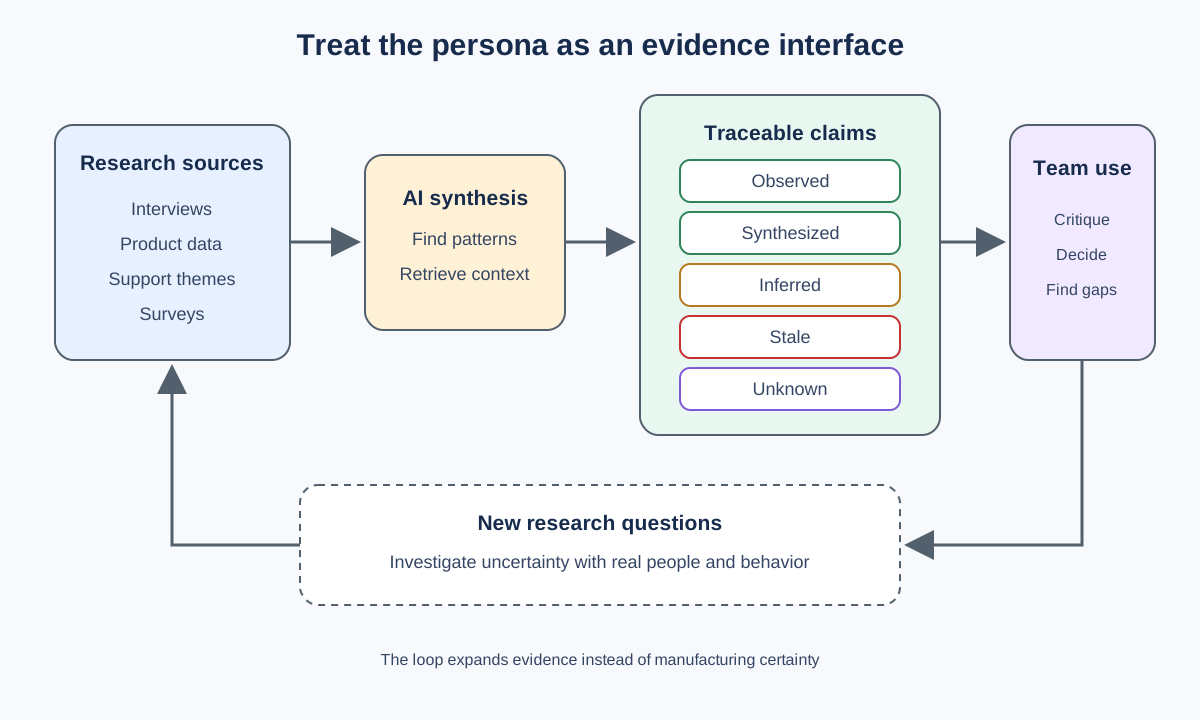
I would separate persona content into five evidence states:
- Observed: directly supported by research or product data, with the source and date attached;
- Synthesized: a pattern drawn across multiple sources — no single source states it, the combination does;
- Inferred: a reasonable interpretation that still needs validation;
- Stale: once supported, but the evidence predates a meaningful product or market change;
- Unknown: a question the available evidence cannot answer.
That distinction matters more than making the persona sound human.
It also changes how the team uses the output. Instead of asking, “What would Maya do?” the team can ask, “What evidence supports this predicted behavior, and how current is it?” The persona remains useful, but it stops pretending to know more than the organization knows.
Use the Persona to Find Questions, Not Manufacture Answers
The strongest use of a generated persona may be showing the team where its confidence is thin.
Imagine a team considering a new onboarding path. The persona can retrieve known barriers, compare the proposal with previous interview themes, and surface differences between audience segments. Done well, the output reads less like a character and more like an annotated brief: setup friction is observed across fourteen interviews; what happens when someone returns after a month is unknown — no source covers it.
That is useful. The tool has made a research gap visible before the team turned it into a product decision.
The weaker version asks the persona to predict which concept users will prefer and treats the response as validation. The model will probably answer. It may produce a thoughtful rationale. But the answer still comes from the material and assumptions already inside the system. It cannot observe surprise, notice a participant struggling with language, or discover that the team framed the problem incorrectly.
A simulation can rehearse a question. It cannot create the missing encounter with reality.
This connects to something I wrote in Four Questions That Help Product Teams Decide. Good questions change how a team thinks and decides. An AI persona should help generate those questions: What are we assuming? Which segment is absent? What behavior contradicts this pattern? What changed since the source research? What would we need to observe before committing?
The output should create a better research plan, not an excuse to skip one.
Test the Persona Against Known Cases
Before using a generated persona in product planning, I would test whether it can represent evidence the team already understands.
Give the system a question with a known answer. Ask it about a behavior documented across several sources. Check whether it cites the right material, preserves disagreement, and avoids adding details that are not present. Then give it a question the research cannot answer.
A dependable system should expose the limit.
There is also a more immediate risk, and it has nothing to do with model quality: what the team feeds the system. Raw interview transcripts contain names, health details, financial situations — exactly the material that should never sit inside a shared, queryable tool. Persona systems should only ever see curated, privacy-safe sources: redacted excerpts, aggregated themes, behavioral data with identifiers stripped. If the tool needs the raw material to sound convincing, the interface is wrong — the privacy bar is not what should move.
This is similar to the standard I described in AI-Generated Tests Need to Earn Your Confidence. A polished artifact is not proof that the artifact protects the behavior that matters. You need to make it encounter a condition that should fail.
For an AI persona, that means evaluating questions such as:
- Does it distinguish source evidence from model inference?
- Does it preserve minority or contradictory findings?
- Can it say that the available research is insufficient?
- Does it reveal when the underlying evidence is old?
- Can a researcher inspect the cited source in context?
- Does it avoid exposing sensitive participant information?
- Does it change appropriately when new evidence is added?
If every question produces a confident answer, the system is not becoming more useful. It is hiding uncertainty from the team.
Protect the Differences Between People
Synthesis always risks smoothing away the edges. AI can do it at scale, and invisibly.
A persona built around the most common pattern may underrepresent people with different abilities, languages, technical confidence, or access constraints. The AI-specific risk is opaque weighting: which sources counted most? Did a large volume of easy-to-parse support tickets drown out six deep interviews? Are survey completers standing in for the people who abandoned the survey? Does the persona describe an average nobody resembles?
The fix is not more fictional detail. It is keeping segments, exceptions, and confidence visible enough that the team can make an informed choice.
Sometimes the most important output is not a persona at all. It is a tension: two groups need different things, and the team has been designing around the people who are easiest to hear.
Give the Tool a Clear Role in the Research System
The value of an AI persona depends on the role the team gives it.
It can be useful as a research librarian, synthesis partner, planning prompt, or critique layer. It can help a new team member understand existing evidence. It can compare a proposed flow with known needs. It can surface stale assumptions and help researchers decide where to look next.
It should not be introduced as a synthetic customer whose opinion settles a debate.
A practical operating model might look like this:
- Researchers curate approved, privacy-safe sources.
- The system generates claims with citations and confidence labels.
- The team uses those claims to critique decisions and identify gaps.
- Real research investigates the gaps that carry meaningful risk.
- New evidence updates the system and changes what it can responsibly say.
That loop preserves the leverage without confusing retrieval with discovery.
AI can make customer knowledge easier to reach. That is a meaningful improvement. Most teams already know more than they can find at the moment a decision gets made.
But access to old evidence is not the same as learning something new, and a simulated response is not a person responding.
The persona can bring the research into the room. It should also remind the team when it is time to leave the room and talk to people again.