
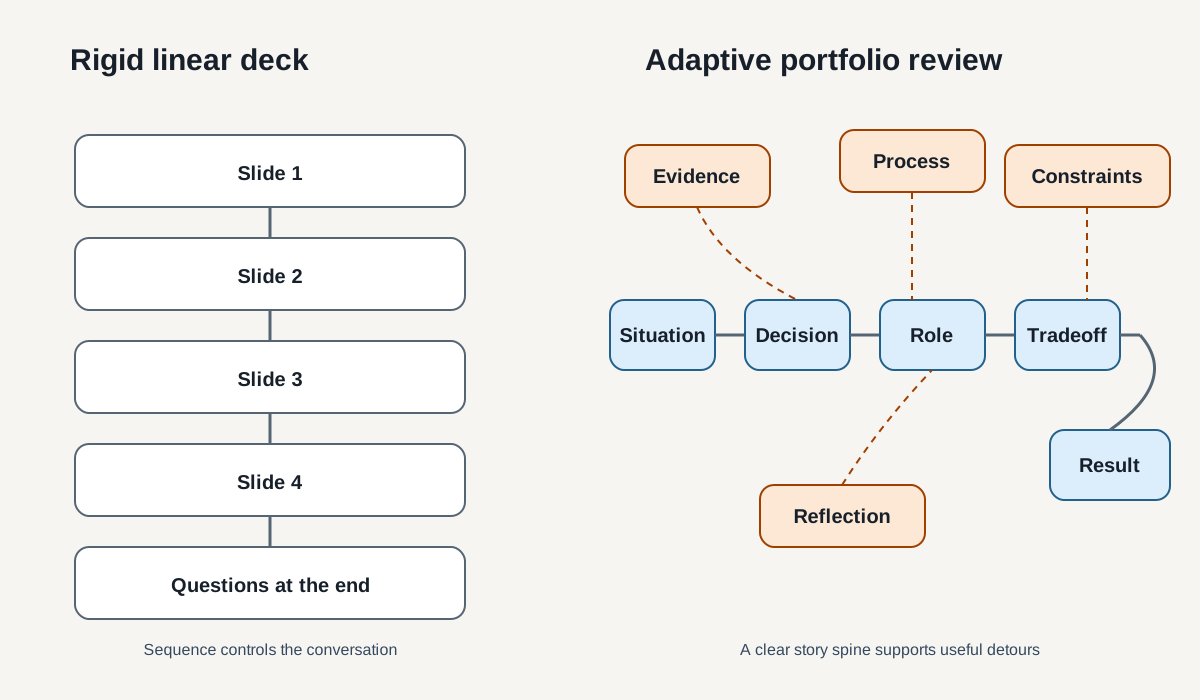
The same tension keeps showing up in portfolio reviews with designers preparing for senior and leadership roles.
They've done the work. They know the decisions, the constraints, the outcomes. Then the presentation starts, and all of it gets compressed into a fixed sequence of slides. The interviewer asks a useful question on slide six, and the designer has to choose: answer it honestly, or say "I get to that on slide twenty-three."
A portfolio review isn't a presentation with questions at the end. It's a working conversation with enough structure to keep everyone oriented.
The best ones I've seen make room for that conversation. They have a clear story without being trapped by it — the designer can follow the question that matters without losing the thread of the work.
The Linear Deck Solves the Wrong Problem
A slide deck is good at controlling sequence. That helps when the goal is to deliver the same information to a room in the same order.
An interview is different. The people in the room are trying to understand how you think, where you had influence, and whether your experience maps to the problems they need someone to solve. A product leader may want to understand the business decision. An engineer may care about the constraint that changed the interaction. A design leader may want to know how you developed the team around the work.
Those are not interruptions. They are the review.
A rigid deck can turn useful curiosity into a timing problem. The designer rushes to protect the remaining slides, the interviewer holds a question until it is no longer relevant, and the conversation stays at the surface because both people are serving the presentation.
The deck gets completed. The understanding does not.
This is close to the distinction I wrote about in Frame Your Design Work Around Decisions, Not Deliverables. A portfolio is not just a record of activities. The way you frame the work reveals your relationship to the problem, the team, and the decisions that shaped the outcome.
Build a Spine, Then Create Branches
Flexibility does not mean showing up with a loose board full of artifacts and asking the interviewer where they want to begin.
The presentation still needs a spine: a short path through the project that makes the work understandable even if nobody asks a question.
I would build that path around five things:
- The situation. What was happening, and why did it matter?
- The decision. What did the team need to choose or learn?
- Your role. Where did you shape the work, and who shaped it with you?
- The tradeoff. What did the team prioritize, change, or leave behind?
- The result. What happened, what did you learn, and what remained unresolved?
That can be a ten-minute story. It gives the room enough context to know what questions are worth asking.
Around that spine, create branches for the parts people may want to inspect: research evidence, early directions, technical constraints, team structure, detailed flows, measurement, or what you would do differently. Those sections do not all need equal airtime. They need to be easy to reach when the conversation makes them relevant.
A slide deck can support this with a strong table of contents and linked appendix. A Miro or FigJam board can make the branches visible beside the main path. The tool matters less than the structure.
Follow the Question Without Losing the Story
The difficult part is not creating the branches. It is knowing when to leave the main path.
A simple test works here: if the question helps the room evaluate how you would work with them, follow it.
If an engineering leader asks why the team rejected a technically simpler direction, that is probably more valuable than the next three process slides. If a product leader asks how you knew the problem was worth solving, stay with the evidence. If the hiring manager asks how you handled a disagreement, do not postpone the answer because the collaboration section comes later.
Answer the question, then reconnect it to the spine:
> “That constraint is what changed our original direction. Let me show you the decision it led to.”
That sentence does two useful things. It respects the interviewer’s curiosity, and it keeps the story from becoming a tour of disconnected artifacts.
This is one reason designers who lead through inquiry often do well in portfolio conversations. They are not waiting to deliver the complete answer. They are listening for the question underneath the question.
“Did you do the research?” may really mean, “Can you make a decision without perfect evidence?”
“How did engineering respond?” may mean, “Can you work through a constraint without treating it as resistance?”
“What was your exact contribution?” may mean, “Can you explain your influence without claiming the team’s work as your own?”
A good portfolio structure gives you room to answer what the interviewer is actually trying to learn.
Prepare for Depth, Not More Slides
Designers often respond to portfolio anxiety by adding content. Another process diagram. More final screens. A slide for every workshop. The deck becomes complete enough to answer any possible question and too long to support an actual conversation.
I would prepare differently.
For each project, identify four or five questions that could change the direction of the review:
- What assumption did you challenge?
- Which constraint had the greatest effect on the work?
- Where did your first direction fail?
- How did the team make the final tradeoff?
- What evidence would make you revisit the decision?
Then prepare the artifact and the short answer that make each one concrete.
The research plan is less useful than the finding that changed the scope. The complete design file is less useful than the two states that reveal the hardest interaction decision. The roadmap is less useful than the moment the team decided what not to build.
Depth comes from showing the evidence behind a judgment, not from displaying everything the project produced.
AI can help pressure-test this preparation. Ask it to play a skeptical product leader, engineer, or design executive. Have it interrupt the story and ask for evidence. Notice where your answer depends on a later slide, where your role becomes vague, or where the outcome sounds cleaner than it really was.
Then fix the reasoning, not just the deck.
That follows the same principle as showing your judgment when AI makes the first draft. The tool can help expose a weak explanation. You still have to decide what is true, relevant, and yours to claim.
Make the Room Part of the Review
At the beginning, tell people how you want the conversation to work.
Something as simple as this can change the tone:
> “I have a short path through the project, with detail around the decisions, research, and implementation. Please interrupt when something is useful to explore. I can adjust the route as we go.”
That is not a disclaimer. It is facilitation.
It shows that you can create structure without controlling every moment. It also gives the interviewers permission to participate instead of waiting politely for the final slide.
The same behavior matters on a product team. Senior designers and design leaders rarely work from a script. They enter a room with a point of view, listen for what is missing, make the relevant evidence visible, and help the group move toward a decision.
A portfolio review can demonstrate that operating model in real time.
The Review Is Part of the Evidence
I used to think of the portfolio as evidence from the past. Here's the project, here's what happened, here's what I contributed.
The review itself is evidence too.
How you handle an unexpected question shows how you work with uncertainty. How you move between the business objective and the interaction detail shows whether you connect levels of the problem. How you credit partners shows what collaboration means when you're not speaking in abstractions.
A polished linear story can describe those abilities. An adaptive conversation demonstrates them.
None of this means abandoning slides or turning every interview into an unstructured workshop. Build a clear path. Know the decision you want the room to understand. Prepare enough depth to support the claims you make — then leave room for the conversation to change the route.
Your portfolio shouldn't prove you can get through a deck. It should help the people in the room understand what it would be like to work through a problem with you.