
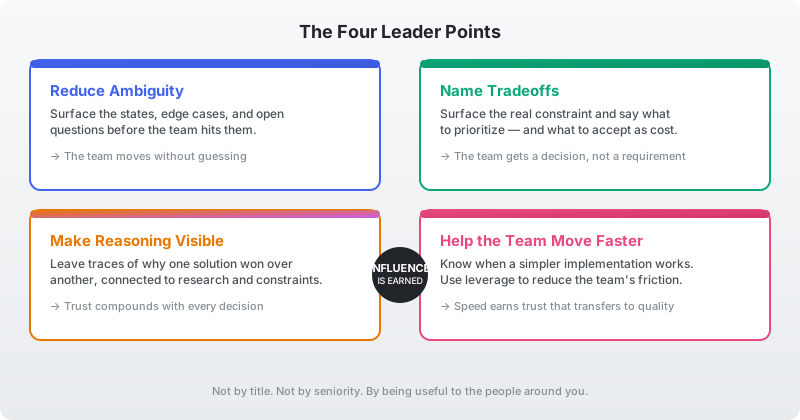
Designers earn influence when product and engineering trust their input to improve a decision—not when a title gives them permission to speak.
The usual advice is useful but incomplete: join the conversation early, speak the language of the business, and show measurable impact. Influence also depends on the daily work that makes teammates want a design perspective.
Four ways to earn influence
1. Reduce ambiguity before anyone asks
Product teams spend too much time reconstructing information the designer already knows. Surface the open question, edge case, and real-data state before someone else hits it.
A designer who annotates loading, empty, error, and edge-case states before engineering asks reduces rework. A designer who produces twice as many happy-path screens does not provide the same value.
2. Name tradeoffs before they become blockers
Defending every detail weakens trust. Explaining what the team should prioritize—and what it can accept as a cost—helps people decide.
"This interaction is worth the complexity because it prevents a common user error. We could simplify it by accepting a slightly longer flow" gives the team a choice. "This is the right experience" gives them a requirement.
As I wrote in From Design Artifacts to Product Outcomes, the artifact supports a decision. It is not the end of the work.
3. Make the reasoning visible
Design decisions that stay in a designer's head do not travel. Product rewrites the ticket, engineering interprets the screen, and the intent disappears.
Explain why one option won. Connect the choice to the research or business constraint behind it. Leave enough context for the team to understand the decision without the designer in the room.
That visibility compounds. The team begins asking for the reasoning before a decision because past reasoning proved useful.
4. Show where the team can move faster
Influential designers protect quality and help the team ship.
That can mean choosing a simpler implementation that preserves the user benefit, removing an unnecessary interaction before engineering builds it, or using AI to draft acceptance criteria from a design walkthrough. The Unsexy AI Work explores that last example in more detail.
Teams notice when design helps them move. That trust creates more influence on the decisions that matter.
How AI changes the effort
These behaviors are not new. AI lowers the cost of practicing them.
Designers can use AI to generate edge cases and surface gaps in minutes. They can also draft a structured rationale from a walkthrough, inspect whether a component supports a needed behavior, or flag an implementation risk before engineering starts.
The behaviors remain the same. The effort required to perform them has dropped.
What influence looks like day to day
Influence appears in small moments:
- A product manager asks for the design perspective because the decision needs it.
- An engineer says a design change prevented a week of rework.
- The team includes design in technical tradeoffs because prior input improved the result.
Those moments matter more than the title on the org chart or a symbolic seat at the table. They show that the team makes better decisions when design is involved.
Earned, not assigned
Designers earn influence by reducing friction, naming the hard choice, showing their reasoning, and helping the team move.
AI can make those actions cheaper and faster. It cannot replace the judgment required to know which action matters.