
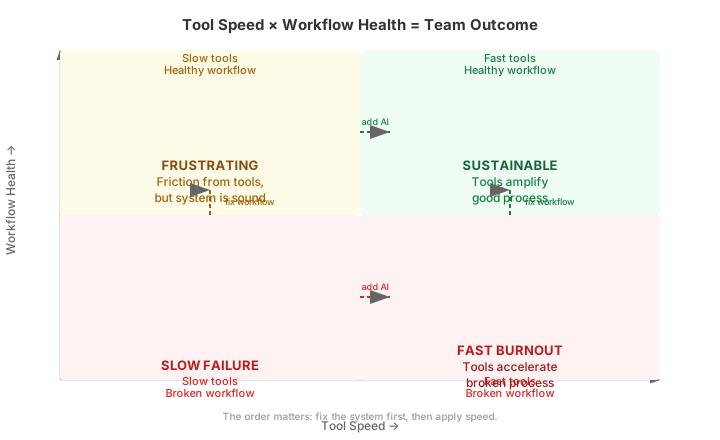
AI and automation can make product teams faster. If the workflow is unclear, that speed can also multiply rework, meetings, and output that nobody needs.
Faster tools cannot fix a broken system on their own. They can accelerate its failures.
The productivity paradox
Consider a common pattern. A team adopts AI to generate tickets from design walkthroughs. The tickets become more complete, engineering asks fewer questions, and the handoff looks smoother.
Three months later, designers produce more screens and attend more review meetings. Product managers manage more refined tickets but spend less time with users. Engineering integrates faster but questions design intent less because the tickets look complete.
The example is illustrative, but the risk is real: speed inside a misaligned system creates more of the wrong output.
Burnout advice often focuses on the individual—set boundaries, take breaks, practice self-care. Teams should also examine the workflow: where does the work create drag faster than people can absorb it?
Where the system leaks
The same problems appear across teams of different sizes and industries.
Unclear decision rights. When nobody knows who decides, work stalls or repeats. Progress depends on negotiation instead of an agreed operating model.
Handoff churn presented as collaboration. Design sends a file. Engineering finds a missing state. Design updates the file. Product rewrites the ticket. The loop repeats because the team is reconstructing intent instead of sharing it.
Duplicated documentation. The design file, ticket, and planning document disagree. Nobody trusts one source, so everyone maintains a separate version.
Pressure for speed without a clear constraint. Each function optimizes its own output while the delay between functions remains. Design finishes screens sooner, product writes tickets faster, and engineering ships code more quickly, but the full system does not improve.
The Unsexy AI Work explains how AI can reduce translation work across design, product, and engineering. That benefit depends on a healthy workflow. Automating a broken loop only makes it run faster.
What changes the system
Teams that sustain their pace tend to share four practices.
Name the decision-maker before the decision arrives. Define who owns product direction, technical approach, and scope.
Treat handoffs as translation points. Expect questions and budget time for them. A complete-looking handoff does not guarantee complete understanding.
Keep one source of truth. Agree where the current decision lives, update it when the decision changes, and close stale sources.
Measure judgment as well as output. Teams evaluated only on screens or closed tickets will optimize for volume. Include the quality and effect of decisions in the review.
The role AI should play
Use AI to reduce the distance between a decision and its execution. A tool can flag missing states before a design reaches engineering, summarize what changed in a decision meeting, or draft documentation from the work itself.
These uses reduce reconstruction. They do not add another layer for the team to maintain.
AI can make a healthy system run more smoothly. It cannot create the system for you.
Start with the workflow
Before choosing a tool, map the friction:
- Where does the team recreate information that already exists?
- Which assumptions surface only after a handoff?
- Where do decisions disappear before the next conversation?
- What work does the team produce but never use?
Fix those leaks first. Then use AI and automation to make the improved workflow faster.
A good tool on a clear system is a multiplier. On a broken system, it is an accelerant.