
He had done everything right. Collected the questions he expected, written detailed answers, added examples, rehearsed the wording — enough material to handle almost anything.
Then the practice interview started, the first question arrived in a slightly different form, and most of that preparation became impossible to reach.
More preparation had created more to remember. It hadn't made the conversation easier.
A strong design interview doesn't depend on a polished answer for every possible question. It depends on knowing a small set of stories well enough to adapt them to the one in front of you.
Memorized Answers Are Brittle
Interviews create an understandable desire for control. The candidate does not know exactly what will be asked, who will ask it, or what the interviewer is actually trying to learn. Writing complete answers can make that uncertainty feel more manageable.
But the interview rarely follows the script.
“Tell me about a time you handled ambiguity” might actually be a question about how you set direction. “How do you work with engineering?” could be about conflict, technical tradeoffs, or whether you involve partners before the design review. A question about failure may be testing ownership rather than the size of the mistake.
If you prepared one fixed answer for each phrase, you now have two jobs: decide which script matches and reproduce it while maintaining a real conversation.
That is a lot of cognitive work at the moment you need to listen most carefully.
The result often sounds strange even when the content is good. The candidate rushes through context the interviewer already understands, misses the concern inside a follow-up question, or keeps searching for the exact sentence they practiced. The answer becomes less clear because the person is trying to retrieve it correctly.
Preparation should reduce that load, not add to it.
Build Three Stories With Enough Range
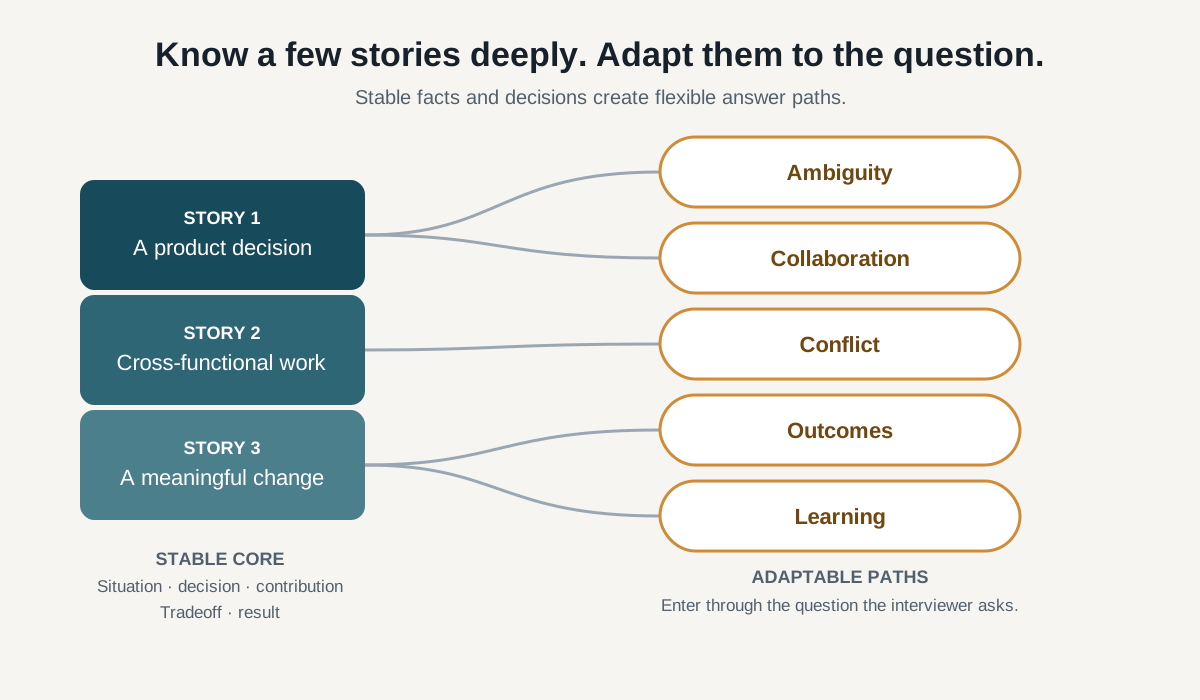
The smaller system that works: choose three stories that reveal different parts of how you work.
For a senior product designer or design leader, that might include:
- A difficult product decision. The team faced uncertainty, conflicting evidence, or a meaningful tradeoff.
- A cross-functional moment. Product, design, and engineering did not begin in the same place, and you helped the group move.
- A change in the work or the team. Something failed, the environment shifted, or you helped another person become more capable.
These do not need to be your three largest projects. They need to contain useful decisions.
A good story can answer several questions because real work is not divided into interview categories. The same project may show how you handled ambiguity, influenced a stakeholder, responded to research, changed scope, and learned from an outcome that fell short.
The goal is not to force every question into one of three canned examples. It is to know a few situations deeply enough that you can enter each story through the door the interviewer opens.
Know the Structure, Not the Speech
Each story still needs structure. Without it, familiarity can become a long tour through everything that happened.
I would prepare five anchors:
- Situation: What was happening, and why did it matter?
- Decision: What did the team need to choose, learn, or change?
- Contribution: What did you specifically do, and who did you work with?
- Tradeoff: What did the team prioritize or leave behind?
- Result: What changed, what did you learn, and what remained unresolved?
Write those as short bullets, not paragraphs. Keep the numbers, dates, team size, and outcome measures nearby because factual details are easy to lose under pressure. Do not write the transitions between them.
This is similar to the narrative spine I described in Your Design Portfolio Should Be Built for Questions, Not Slides. You need enough structure to keep the room oriented, with enough flexibility to follow the question that matters.
The distinction is important. A memorized speech tries to preserve wording. A story structure preserves meaning.
When the interviewer asks about conflict, you can spend less time on the general project setup and more time on the disagreement, the evidence each person held, and what allowed the team to decide. When the question is about business impact, the same story can begin with the objective, connect the design decision to it, and be precise about what the result did or did not prove.
The facts stay stable. The emphasis changes.
Use Clarifying Questions to Improve the Answer
Candidates sometimes worry that asking a question will make them appear unprepared. In practice, a good clarifying question often shows the opposite. It demonstrates that you do not treat ambiguous language as shared understanding.
If someone asks, “Tell me how you lead through ambiguity,” you might ask:
> Are you most interested in ambiguity around product direction, or ambiguity in how the team needed to work together?
If the question is, “How do you collaborate with engineering?” you might ask:
> Would it be more useful to hear about early product definition or a technical constraint that changed the design?
These are not stalling tactics. They help you understand what evidence would be useful. They also move the interview away from a performance and toward a working conversation.
That matters because the interviewer is not only evaluating the story. They are getting a small sample of what it feels like to solve a problem with you.
The same principle appears in Four Questions That Help Product Teams Decide: a useful question reduces ambiguity and changes the quality of the decision that follows. An interview is one more place where that behavior is visible.
Practice Retrieval, Not Recitation
Once the stories are selected, practice them from different starting points.
Take one story and answer five prompts:
- Tell me about a time you changed direction.
- Tell me about a disagreement with a partner.
- How have you connected design work to a business goal?
- Describe a result that did not meet your expectation.
- What would you do differently now?
Do not give the same answer five times. Change the entry point and emphasis while keeping the facts consistent.
Record a few attempts. Listen for the places where you spend too long establishing context, hide your contribution inside “we,” or make the result sound cleaner than it was. The purpose is not to remove every pause. It is to make the story easier to find and easier to shape.
I would also practice stopping. A concise initial answer gives the interviewer room to choose the next branch. You can always go deeper when the follow-up shows what they care about.
This can feel uncomfortable for candidates who have worked hard to prepare every detail. Leaving material unused may seem like a missed opportunity. But an interview is not a completeness test. The strongest answer is the one that gives the room enough evidence to continue.
Preparation Should Make You More Present
Good interview preparation doesn't make you sound rehearsed. It frees up attention for the conversation itself.
You can hear the question underneath the wording. Ask for context when the prompt is broad. Choose a relevant example without mentally searching through twenty scripts. Notice when the interviewer wants to stay with a tradeoff instead of moving to the result.
That presence matters most for senior and leadership roles. The team is trying to see more than whether you finished a project — they want to watch you frame an unclear situation, involve other people, and adjust when new information changes the work.
You don't demonstrate that adaptability by delivering the answer you prepared the night before.
Prepare fewer stories. Know them more deeply. Keep the facts close, the structure clear, and the wording loose enough to respond to the room.
The interview will still be unpredictable. Preparation can't eliminate that. It can give you a way to work with it.